How to Keep Your Food Clean and Safe

The easiest way for bacteria to enter our bodies is through our food. It is always best to be careful when preparing and storing our food in order to avoid food poisoning.
If your family’s meals are to be dependably safe, follow these rules for food storage and preparation:
 Kinetic Go Green Premium Nano Silver 7 Piece Food Storage Container Set
Keep your refrigerator at the right temperature for all foods.  The refrigerator should be 40˚F or colder, your freezer should be set at 0˚F or lower.
 KidCo Freezer Trays - 1-2-3 BabySteps- Step 2 2 ea
Store raw meat and poultry carefully.  Your best bet is putting them in containers or on dishes to keep juices from dripping onto other foods or onto refrigerator shelves.
 FoodSaver FSFRAN0224 Freshsaver Deli Container, 2-Pack
Clean up well after preparing raw meat and poultry.  Always clean utensils, dishes, and countertops with hot, soapy water, so that juices don’t come into contact with other foods.
 GreatCleaners.com-Great Deals on Oxiclean, Kaboom, Orange Glo Arm & Hammer and Cameo! 125x125 banner
Cut raw meat or poultry on a plastic or other nonporous cutting board.  Wooden boards may have cracks in them that make proper cleaning difficult, according to the USDA.  A 1993 study has found evidence that wooden boards actually may be safer than plastic; however, the USDA does not plan to change its recommendation until further researches are completed.  The USDA does advice washing your hands and utensils after handling raw meats and washing all cutting boards, plastic and wooden, in the dishwasher (higher temperatures will kill more bacteria).  Wooden chopping boards may also be disinfected with vinegar.

MIU Flexible Cutting Board, Set of 5Totally Bamboo 20-7920 3-Piece Bamboo Cutting Board Set

© 2010 (Quazen) Athena Goodlight

Protected by Copyscape Original Content Check

Parenting Tips: Safety Precautions While In Pools, Lakes, Rivers, And Boats

Beyond the general water-safety guidelines, there are particular precautions you should take when you are around pools, lakes and rivers, and boats.

POOLS: Create a safe environment.
Experts recommend erecting a five-foot fence around all pool areas (legally required in some states). The gate must be self-closing and childproof. As an added deterrent, a bright red STOP sign on the gate may be placed. Choose a fence with closely spaced vertical pickets or very small chain links to discourage climbing. Also, stow all lawn furniture away from the fence to prevent children from using it as a booster.
Keep floats, long reach poles, and other rescue equipment handy, and practice using them with your children. Always keep your pool covered when not in use – and choose a safe cover. Plastic tarps tend to collect water, creating a drowning hazard. Floating covers, usually made of styrofoam and not attached to the sides of the pool are also dangerous; kids can get trapped underneath. The kind of cover that’s safe, is one that is anchored to the sides of the pool on tracks and automatically retracts by pushing a button.

LAKES and RIVERS: Beware of hidden dangers.
Even the most appealing watering holes can be treacherous to young swimmers. In early spring and summer, icy water temperatures can trigger cramps and breathing problems. Check the water temperature beforehand. Anything under 60ºF should be off limits.

Wade through the water first to be sure it’s safe; there may be trouble underfoot. Look out for broken glass, rusty pop tops, and other debris. Keep feet protected by insisting your kids wear water shoes. Some creeks and rivers have currents strong enough to topple small children, or bottoms that drop off precipitously. Water that’s waist-high one moment can be above your head the next.

BOATS: Always use lifejackets.
Choose only Coast Guard-approved jackets, have the whole family wear them, and test them regularly for punctures and waterlogging. Most jackets are designed to flip you onto your back and keep you afloat. It is advisable to let kids wear life jackets in the water so they’ll be familiar with the feeling in the event of a boating accident.
 Fundamentals of Water Safety
1. Supervise, supervise. Never let a child go near or in the water alone.
2. All preswimmers and nonswimmers should wear a Coast Guard-approved vest when around the water.
3. Never dive into shallow water.
4. No rough play in the water.
5. Stay away from water during thunderstorms and threatening weather.
Always remember, water can be a lot of fun once you and your kids develop a healthy respect for its power. Water safety can be learned by anyone without taking any of the joy out of summer.


flickr image by brightroyalty

© 2010 (Quazen) Athena Goodlight 

Protected by Copyscape Original Content Check

How the US Became Part of Philippine History

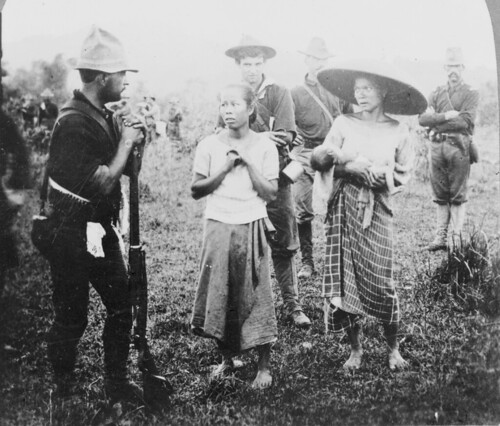
In 1896 the first organized revolution succeeded in overthrowing the Spanish sovereignty. As a result of this Spanish-American War which broke out subsequently, the Philippines was ceded to the United States in the Treaty of Paris, in December 1898. The Filipinos would not give up their hard-won freedom easily; it took the well-armed American troops almost three years before they could occupy the country and establish complete sovereignty.

The American rule was characterized by a rapid progress in self government, in education, in science, and in economic development. Schools, hospitals, and roads were built; new industries were created. A new vigorous and progressive civilization was introduced.

Despite the changes, the Spanish regime had left enduring traits on the Filipino people which cannot be easily changed. During the American occupation (and even up to the present time), the influences of Spanish culture were discernible in certain aspects of Philippine life—the economic, the religious, and the social.
Economically, the effects of the feudal system of landholding largely remained. In fact, American capitalism abetted the concentration of wealth in the hands of a few people. The country folk, who have always depended on the produce of the soil, have stayed in chronic poverty, denied substantial education and the benefits of modern culture. American industry built better roads, faster means of communication, factories, and town, but it failed to modernize farming as a whole during that period. Antiquated methods of agriculture are still widely used even today, with the hand plow and the water buffalo as the standard farm equipment. With a little exception, the rural community has preserved the old ways of livelihood, the peasant folk still engaged in the same type of daily activities.
Visualizing American Empire: Orientalism and Imperialism in the Philippines
In the realm of religion, the traditions of the Catholic Church have been largely preserved. Religious festivals are still occasions for the devout to flock to church and hold elaborate processions. While the American regime fostered the growth of various Christian sects and denominations, notably Protestantism, the Catholic religion has continued to be the dominant influence in the lives of the masses. The Philippines remain to be a predominantly Marian country up to the present.

image source
The Americans instituted a democratic system of education which raised the general social level. The stress on hygiene and sanitation, urbanized living conditions, and material progress improved the health and living conditions of the people at that period, but it has also encouraged unhealthful crowding in the cities, and, to some extent, the neglect of the soil. With education many folk superstitions disappeared. The newspaper, the radio, the moving picture, and television made the rural people better informed of the world about them. English, used as the medium of instruction, soon became the popular language, superseding Spanish, which, however, continued to serve as an alternate tongue. Eventually Pilipino or Filipino, the term applied to the national language, has become widely used in mass media and everyday discourse.
As a result of the new education, folk culture as a whole became remote to the experience of the ordinary person. This was also the period of the rise of the middle class Filipino.

The Philippines: Past and Present (Volume 1 of 2)
The United States stayed in the Philippines for almost half a century, interrupted only by the brief Japanese occupation from 1942-45. In 1946, the Philippines became an independent republic, although the American naval and air bases still remained in the Philippines for many more decades. Up to the present, the USA and the Philippines continue to foster a close socio-political relationship.


 ©  2010 Athena Goodlight

Protected by Copyscape Online Infringement Checker

Facts About Subterranean Termites

Though there are actually several different species of termites, the kind that does practically all of the damage to homes is the subterranean termite. As its name means, this type lives underground, building colonies in damp regions wherever a source of wood (its main food) is available in the soil. The colony reproduces rapidly; then, as its population increases, worker termites are sent out in search of other sources of food. They prevent exposure to both daylight and open air and, if possible, will work their way into the wooden structure of nearby houses without exposing their supply lines.

Since termites can’t survive except under moderated conditions of moisture and temperature, they’ll never expose themselves to the drying effect of open air, except on swarming time in the spring. Termites will burrow through the soft parts of an entire wood beam without breaking through to the outside. As an outcome, the destructive effects can sometimes go absolutely unnoticed until the damage is so serious that complete crumble takes place. Nonetheless, this type of damage would take a lot of years, so even when an infestation is ultimately detected, there’s no need to panic or to act hurriedly.
Termite Extermination for Home Owners: How to Get Rid Of Termites Forever!
Wherever possible, subterranean termites will work below the surface of the ground to bore into those wooden members which come in direct contact with the soil. Still, these ingenious insects will also build up mud tubes or tunnels through gaps in masonry foundations, through the hollow cores of cement blocks and even on the surfaces of metal pipes, foundation walls and similar surfaces. In extreme cases, termites have even been recognized to build tubes straight up—unsupported —to bridge from the ground in a damp crawl space to wooden beams overhead.
The Ultimate Collection Of Tips For Attacking Termites At Their Deepest Source: Low Cost Termite Control Tips To Treat Termite Damage, Stop Termite Infestation ... Enjoy A Termite-Free Home For Years To Come
The mud like tubes or tunnels named above vary in size from 1/2 to 1 1/2 inch in width, and they’re half-round in cross section. They enable the termites to travel to and fro from the underground colony to the wooden structure without exposing themselves to sunlight or open air. The termites need to return to the ground at least once a day to refill their supply of moisture and to bring food to the other members of the colony.
The Truth About TERMITES - How To Treat Termite Damage And STOP Termite Infestation
When a colony becomes large enough, warm weather is the sign for the younger kings and queens, the reproductive members of the colony, to fly out in their yearly attempt to establish new colonies. On this period they fly about in the open air on mating flights, then cast off their wings before settling for good into their new underground homes.
A GUIDE TO TERMITE DETECTION AND PREVENTION
It’s the appearance of a swarm of these flying insects or of a multitude of discarded termite wings near a wall that frequently gives the homeowner his first warning that one or more established termite colonies are situated nearby. In some cases these swarms may be mistaken for flying ants, since both insects appear similar to the uninitiated eye. Actually, the deviation in appearance is quite pronounced. The termite has a relatively straight, oblong body of equal thickness along its total length. The ant has an hour-glass-shaped, segmented body which is linked up in the center by a thin, wiry stem. Termites are generally less than half an inch in length, and their wings will be opaque and milky in color. An ant’s wings are transparent, with dark veins obvious.

References:
The Complete Book of Home Inspection by Norman Becker
Termites and Borers: A Homeowner’s Guide by Phillip Hadlington and Christine Marsden

© 2011 Athena Goodlight

Protected by Copyscape Web Copyright Protection Software

Human Personality Traits That Make Us Reject Change

Change is the only thing constant in this world. But in reality it is ironic that only some people readily embrace change while others resist it. Why?

First, let us define what “change” is. What is “change?” A person’s definition of change varies depending on one’s age. A young person perceives change as a part of growing up — change of height, appearance of hair growth, change of voice. But later in life, a person builds a clearer idea of one’s self. The concept of change then develops. He or she then sees it as a need to adapt. Personality changes happen based on one’s social dealings and confronting situations. However, a person should not allow change unless he or she agrees to it. There must be a personal examination of how one values his or her own self and the situation that requires one to change.

There is actually no need for someone to project a perfect personality. It is pointless. People should accept you for who you are.

What are the reasons for resisting change?

The Fear of Change

Sometimes situations and other people may impose change upon others. A person has the right to assess and challenge the change that he wants for himself. Not everyone favors change. To some, change is not welcome because they don’t see a need for it. There should be a stimulus to motivate a person to change.

Pride
Some people are just too proud to change. This is why new concepts and ideas are better absorbed by younger minds. As people age they become more resistant to changing their belief system—some to the point of bigotry until death.

Any form of change is stressful and can be confusing.
This is one of the main reasons why change can’t be done. Not all can cope with change. People have different levels of abilities to adapt. Change is most critical during the teenage years. They get confused with the many changes that are happening in their lives. For instance, they may get reprimanded for doing things they are too young to do and for not doing things that they are supposed to because they are old enough.

Family influences change.
A person raised in an unhappy family will understandably seek stability upon reaching adulthood. On the other hand, someone who grew up in a stable family environment will more likely seek change.

Our values are primarily setup by our parents and change when we interact with other people. If we could discern, we know which values to keep. For instance, we all know that we are expected to be honest; but if dishonesty, lying, or pretense is openly practiced in a family, those family “values” still adhere to a person’s character because it is already set up, both subconsciously and consciously beginning from the formative years of a person. Oftentimes, only a traumatic experience can change a person.

Habit is more comfortable.
Because humans are creatures of habit, “we get used to being a certain way, even if it doesn’t work very well,” say Jack Canfield and Mark Victor Hansen in their book, The Alladin Factor.

They add, “Many of the things that are required to build and maintain high self-esteem may sometimes be uncomfortable.”

Now that we have identified what makes change so difficult, hopefully we can assess ourselves and situations easier when faced with a challenge to change something within us and around us. Are the factors really life threatening, or are they just superficial?

© 2010 Athena Goodlight

Protected by Copyscape Web Plagiarism Scanner

The Marine Turtles: Beautiful, Exotic, and Endangered

Sea turtles, these four-legged shelled reptiles have inhabited the earth since prehistoric times. Unfortunately, overhunting, illegal trade, and sea pollution have caused their population to continually dwindle.

There are two turtle families (Cheloniidae and Demochelydae), five genera and eight known living species of sea turtles. They are differentiated by their flattened forelimbs, each with a single claw. Freshwater turtles have five easily distinguishable claws on each forelimb. Of the eight remaining species of marine turtles in the world, six are found in the Philippines. The UNESCO World Heritage considers the Turtle Islands in the Philippines as the only major nesting ground, hosting more than 1,000 annual nesters of the giant Green Turtles (Chelonia mydas) in the whole ASEAN region.

The Turtle Islands (Kalayaan Group of Islands) atolls in the South China Sea and is being claimed by several countries including the Philippines. The marine turtles found in the different islands in the Philippines and the Indo-pacific region are the green sea turtle, the loggerhead, the hawksbill, the leatherback, the olive Ridley, and the flatback. Most of these species are migratory, crossing vast distances of tropical and subtropical oceans to and from their nesting and feeding grounds. Once, a loggerhead turtle from Yakushima Island, Japan, was captured off Pilas Island in Basilan, about 3,000 kilometers away.

Green Sea Turtle

Well-adapted to life in the sea, marine turtles can dive for long periods of time and swim powerfully. The leatherback turtle, the largest of the sea turtles, is capable of diving at depths exceeding 1,200 meters. The leatherback, called kantuhan in Palawan, Philippines and manahanga in Sulu and Tawi-Tawi, got its name from its leathery covering which distinguishes it from its hard-shelled relatives.
a leatherback turtle covering her eggs - image source

Marine turtles have no teeth and use a sharp, bony beak and jaws to tear and bite their food. They feed mostly on jellyfishes, crabs, shrimps, fishes, algae, and sea grasses. Their senses of sight, taste and touch are well developed. Due to the absence of vocal cords, the only sounds they can make are hissing and grunting noises while exhaling during courtship and mating.

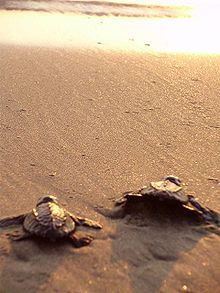
Nestling turtles lay eggs of different number and size per nest according to species. Hawksbill turtles lay 50 to 250; loggerheads and olive Ridleys lay an average of 120; leatherbacks lay 85 to 120; and green sea turtles lay 40 to 190 eggs per nest. The eggs are leathery and resemble white ping pong balls. It takes 52 to 62 days before they hatch. Throughout the incubation period, the eggs are preyed upon by monitor lizards, crabs, birds, rodents, stray cats and dogs. But the most ravenous predator is human. two olive ridleys
image source

The hatchlings’ first year of life is planktonic or “free swimming.” Offshore, they are preyed upon by fish and other marine creature. Those who survive migrate to some unknown habitat. Marine herpetologists call this stage the “lost years.” Upon reaching sexual maturity, they will return to their birth place, guided by a mysterious instinct, to start reproducing. Less than 1% of the hatchlings that emerge from the nest will survive to reach adulthood. And because of man-made intrusions in the life cycle, less than 1% live up to the reproductive stage. Sea turtles are classified by the International Union for Conservation of Nature (IUCN) as “endangered.” Conservationist groups have been established to protect these species from becoming extinct. In the Philippines, an administrative order was issued prohibiting the capture and trade of marine turtles or any of its by-products.

Although the green sea turtle is the most abundant among the six species found in the Philippines, its number continues to decrease. Conservationists have seen alarming percentages of decline in the population of marine turtles—the main cause of decline is man-made. Turtles are hunted in the sea or slaughtered on the beach while they lay their eggs. Their meat and eggs are taken as food, while their skin and shells are processed into various by-products such as jewelry.
Hawksbill turtle image via Wikipedia

The hawksbill’s carapace is highly priced as tourist souvenirs whether stuffed or made into novelty items such as bangles, combs, and jewelry boxes. Thousands of these species are slaughtered yearly. Its population decline has been recorded at 80% as of 2009. Today the population of sea turtles remains in dangerously low levels. It is saddening that these beautiful creatures are being slaughtered just for money.

image source

The Man Who Saved Sea Turtles: Archie Carr and the Origins of Conservation Biology Fire In The Turtle House: The Green Sea Turtle and the Fate of the Ocean

Protected by Copyscape Duplicate Content Detection Software

Help a Struggling Reader With One-on-One Tutorial Sessions

Reading problems can be prevented if the indicators are found early and intervention is enforced at once. Tutoring can be one of the alternatives but it can be critical. Tension amidst tutoring elements may cause positive or negative results on the learning process. All starting reading instruction must contain a balanced oral reading for fluency, alphabetic and comprehension according to a study. Effectual tutoring requires carefully graded materials as it allows for kids to be placed in accordance to their instructional level.
The Ultimate Collection of Childrens Literature (10 Books)
Another important component to look into is the relative frequency and duration of tutoring. According to Susan B. Neuman and David K. Dickinson, "reading recovery" lessons tutoring program for instance, must be done in 30 minutes and continued each day from 12 to 20 weeks. The routine can only be halted when they reach a level of performance consistent with their classmates in the middle reading group or when they already show features of problem solving with new words and sovereign processing of texts.
A Max Lucado Children's Treasury
Further, they cited that in "Success for All tutoring" program, kids are given 20 minutes daily in 8-week cycles tutorial classes. Then, their betterment/performance is observed within that period. Depending on the results, kids are evaluated whether they could be circulated in or out of tutoring. In "Success for All" tutoring, it is important for kids to be tutored as long as they need it. In direct contrast, "Success for All" tutoring is only given 2 days of training along with all other first reading teachers in the school.
THE CHILDRENS BOOK OF CHRISTMAS STORIES
In tutoring programs like "reading recovery" tutors are fundamentally mentored for a full year by a "reading recovery" trainer. Through with the one whole year, tutors are taught to make in progress decisions about tutoring tasks that are responsive to the knowledge and interests of the kid. In essence, success depends upon the acquired knowledge of the tutor who is particularly trained to perform a daily changes in the response of the child.
Free Childrens Books and Young Adult Books for Kindle: Linked List of Over 1,000 Free Classics For Boys, Girls and Teens (Free Kindle eBooks)
Within the school environment, assessment and instruction must be together to advance student accomplishment in reading. When schoolroom teachers only use advance student advancement, it is plausible that useful instructional is lost to over testing. Communication is bounded by the lack of basic parlance and the connection gets lost in the shuffle. Consideration should be given to the student like using common appraisals to inform teachers to ascertain whom to serve with which intercession and where and how.
The Book Whisperer: Awakening the Inner Reader in Every Child
Tutoring plays a significant role to children who are scrambling to read. Research shows that by continuing them to support with additional reading instruction across the classes, the current ratio of children with reading difficulty can be reduced to 5% or less.
Children's Writer's Word Book
Person-to-person tutoring can give direct, systematic, intense instruction that’s responsive to the knowledge and interests to the child. Researchers on reading troubles concluded that the only way to give opportunities for some children to gain normal reading is to provide one-in-one instruction over a significant period of time.
Books Children Love: A Guide to the Best Children's Literature
Building upon rich interpersonal relationships, reading tutors can give individualized, elaborated and specific instructions on the right level, time and child — a task that’s often difficult to achieve in a classroom scene. By enlisting the human resources inherent on every home, school, and community, we can assure that every kid learns to read, one child at a time.


© 2011 Athena Goodlight
Protected by Copyscape Duplicate Content Detection Software